Farine

Crazy for Bread

  • Home
  • About
    • FAQ
  • Recipes
  • Resources
    • BreadCrumbs
    • Other Bread Sites
    • The Grain Gathering
  • Artisans

Search Results for: how to make bread

Two more Parisian bakeries…

Today we had two BBGA-sponsored bakery visits on the agenda before heading out to Europain to cheer the US team during the presentation of its handiwork to the judges. The first visit was to Basile Kamir’s famous Moulin de la Vierge (105 rue Vercingétorix).  Le Moulin de la Vierge (literally the Virgin’s Mill) is located in a historic building and its painted ceilings and ornate display counters are truly a throwback to another time. As is often the case in a Paris bakery, the lab is in the cellar, accessible through a very steep staircase (almost a ladder). It is rather larger than a regular Paris lab but that may be because it is really out there on the outskirts of the city.
Basile Kamir started working on the premises in the late 70’s, albeit not as a baker: he was actually selling records for Richard Branson, his childhood friend and founder of a record mail-order company that would evolve into Virgin Records. The bakery (which dates back to 1907) had been abandoned for five years and the cellar was mostly a favorite hangout for spiders and mice. However the city of Paris had been demolishing the old buildings in the neighborhood to build new housing and soon threatened to take down the bakery as well (Kamir told us of countless power outings because excavators were tearing out underground power cables all around them). The only way to preserve the building was to make it an operational bakery again, which automatically made it off-limits to the wreckers. So he hired a baker with whom he apprenticed and the rest is history (you will find more details here).

M. Kamir showed us his LeFort wood-fired oven (you can read more on that oven in Dan Leader’s Bread Alone), describing how he discovered it behind thick curtains of cobwebs all these years ago and didn’t even know it was in working order until he had it checked by a descendant of the artisan who had originally put it in. He also showed us his levain (which had just been fed and wasn’t as aromatic as it would presumably be later in the day). We didn’t see any bread making as production happens in the afternoon but he told us how he came upon the name Moulin de la Vierge and I thought it too poetic not to pass it on: it so happened that at the time he had a Swedish girlfriend who was originally from Öland Island. He went there on vacation and fell under the spell both of the island and of the hundreds of windmills which dotted its rolling hills. That’s for the “moulin” part. As for “vierge” (which means “virgin”), it is a tribute to the early days when the bakery was a storage and mail-order center for Virgin Records. The fact that there is an eponymous street somewhere in the neighborhood is a mere coincidence.

The other bakery on our list for the morning was Boulangerie Voiriot (61, rue de la Glacière). We were not supposed to meet Monsieur Voiriot himself as he was going to be at Europain that morning but his son, who normally does the morning shift and was going to show us around, had injured his back and couldn’t make it to work.  I was of course very sorry to hear about the son’s medical problem and wish him a speedy recovery but I am delighted to have met with M. Voiriot himself. I didn’t take any pictures of him but if you click here, you’ll be able to meet him and his wife.
Christian Voiriot is passionate about his profession which he tirelessly advocates in baking schools, professional organizations and, as a judge, in national or international competitions. He says that he sometimes works from 3 AM to 10 PM and still wakes up happy the next day: “J’adore mon métier” (I love my job).
He keeps a liquid levain which he uses for his country bread. He has had that levain for many many years. Since the bakery is open year-round (just closed on weekends), he has never had to think about what to do with his levain during vacation-time but he says some of his fellow bakers successfully freeze theirs for three or four weeks with no adverse consequences. Any frozen levain would have to be brought back to room temperature and refreshed once a day for at least three days before showing any sign of activity. It should be usable again after a week.
As was the case in the first two bakeries I visited in Paris, I was struck by the diminutive size of the lab (55 sq. meters, i.e. less than 600 sq. feet). Throw in another 20 sq. meters (215 sq. feet) for the store and you’ll have the full dimensions of the premises. I didn’t take any notes (I was too busy translating back and forth) but I remember M. Voiriot saying that he had once been told he had the highest output rate per square meter for any bakery in Paris. Ten people share this space (three in the store, saven in the back) and they churn out picture-perfect breads, cakes, viennoiseries, sandwiches, etc. An amazing feat!
We were in a rush to get to Europain before the competition was over for the day and since we were not heading home, we didn’t buy any bread but Boulangerie Voiriot is definitely one I am keeping on my list for further visits.

Share this:

  • Share on Facebook (Opens in new window) Facebook
  • Share on Pinterest (Opens in new window) Pinterest
  • Share on X (Opens in new window) X
  • Email a link to a friend (Opens in new window) Email
  • Print (Opens in new window) Print

March 6, 2012 · Filed Under: Bakeries, Events, Paris, Travel · 5 Comments

Hutzelbrot with dried cherries and cranberries

Besides the delightful taste of this bread, what I love about this Peter Reinhard recipe (from his book Whole Grain Breads: New Techniques, Extraordinary Flavor) is that it uses a mash and that the mash can be made in part with “old bread”. To me there is already something deeply satisfying about pre-soaking whole grain flour and having the enzymes start working hours and hours before you even begin to mix your dough but when you can feed them your stale bread too, wow, it’s just too good to pass up!
Reinhart uses (or suggests using, it’s hard to figure out which) a mix of dried fruit for this bread, such as citron, apricots, figs, plums, cherries, cranberries, golden raisins). Even though I had pretty much everything on hand but the citron, I decided to focus the flavors a little more and go for the sweet dried cherries my friend Kim had brought from Wisconsin (each one like a burst of summer in the mouth, thank you, Kim!), paired with slightly tarter dried cranberries from Washington State. I also decided to soak the old bread in apple juice since I had some I needed to use up and it would nicely boost the fruit taste. The bread turned out crusty and surprisingly light.
It takes two days to make which is perfectly fine with me since most of the time the ingredients toil away all by themselves….


Ingredients (slightly adapted): makes 2 batards


For the soaked bread (altus)

  • 1/2 inch-bread cubes with crust left on soaked in hot organic apple juice or water and left at room temperature for at least 4 hours and preferably overnight. Use just enough liquid to saturate and soften the bread. Reinhart advises using rye bread but he says whole wheat is fine too. Squeeze out excess liquid before adding to the mash (I didn’t weigh anything to start with, just used up all my stale bread and made a big bowl of actus. When required by the recipe, I took out the 170 g needed for the mash, weighed the rest, put it in a ziploc bag, labeled it and stored it in the freezer for next time)

For the mash

  • 300 g water
  • 64 g coarse whole wheat (I used flour from Cedar Isle Farm in Agassiz, British Columbia, which my friend Meeghen kindly brought me)
  • 64 g 75% sifted rye flour (I used flour from True Grain Bread on Vancouver Island, British Columbia, which Meeghen also brought me. Thank you, Meeghen, for giving me the opportunity to bake with these gorgeous flours!)
  • 1 g diastactic malt powder
  • 170 g altus

For the starter

  • 71 g whole wheat or rye starter
  • 213 g whole rye flour
  • 170 g water at room temperature (70°F/21°C)
For the dough
  • all of the starter (454 g)
  • all of the mash (397 g)
  • 99 g white whole wheat flour + 200 g (which I had to add because my dough was way too wet, possibly because I had pre-soaked the fruit which Reinhart doesn’t say to do)
  • 99 g whole rye flour
  • 100 g sweet dried cherries (briefly pre-soaked, then drained)
  • 70 g dried cranberries (briefly pre-soaked, then drained)
  • 14 g salt (I didn’t add to that amount even though I added more flour: I just tasted the dough and it seemed fine)
  • 7 g instant dry yeast
Method:

On Day 1

  1. Mix the mash ingredients (save for the altus) (using water heated to 165°F/74°C) making sure the flour is fully  hydrated and the end product resembles a thin pudding or gravy. Cover and keep warm (150°F/66°C) if possible for 3 hours or at least for 60 minutes. Reinhart suggests using the oven for that step (turning it repeatedly on and off if it doesn’t have such a low setting) 
  2. After 3 hours, stir in the soaked bread and refrigerate until ready to use (you can also leave it overnight at room temperature) if you are planning to use it within the next 24 hours
  3. Mix all of the starter ingredients and knead with wet hands to form a ball of dough. Let it rest 5 minutes and knead again. The dough will be tacky. Allow it to double at room temperature (which can take up to 8 hours depending on the temperature). When fully developed, knead for a few seconds, cover tightly with plastic wrap and refrigerate overnight if necessary to coordinate timing with the mash. Remove from the refrigerator about 2 hours before mixing the final dough
On Day 2
  1. Using a metal scraper, chop the starter into 12 smaller pieces, sprinkling some extra flour over them to prevent them from sticking to each other
  2. If mixing by hand (which I did), combine starter and mash in a large bowl with the whole wheat and rye flour, cherries, cranberries, salt and yeast. Mix for about 2 minutes until all the ingredients are evenly integrated and distributed into the dough. The dough should be soft and slightly sticky. If not, add water or flour if needed (that’s where I had to add the extra 200 g of white whole wheat flour as the dough was definitely not going to take shape otherwise)
  3. When dough feels soft and only slightly sticky, form it into a ball and let it rest for 5 minutes while you oil a container
  4. Knead it briefly again for one minute and make any final adjustments to water or flour. It should be malleable and tacky but no longer sticky
  5. Form into a ball again and place in prepared container, rolling to coat with oil
  6. Cover loosely and let rise at room temperature for about one hour or until it is at least 1 1/2 times its original size
  7. Transfer to a lightly floured surface and shape into two batards. Place the batards on a sheet pan lined with semolina-dusted parchment paper. Cover loosely with plastic wrap or a cloth towel and let rise at room temperature for 45 to 60 minutes, until 1 1/2 times their original size
  8. While the batards are proofing, preheat the oven to 425°F/218°C. When ready to bake, dust them with flour and score the loaves as desired using a sharp knife or blade
  9. Place them in the oven (with steam), lower the oven temperature to 375°F/191°C and bake for 25 minutes
  10. Rotate the loaves 180 degrees and continue baking for another 20 to 35 minutes or until the loaves are well-browned and make a hollow sound when thumped on the bottom
  11. Cool on a rack and wait at leasts 12 hours before slicing open.
Enjoy!


The Hutzelbrot with dried cherries and cranberries go to Susan for this week’s issue of Yeastspotting.

Share this:

  • Share on Facebook (Opens in new window) Facebook
  • Share on Pinterest (Opens in new window) Pinterest
  • Share on X (Opens in new window) X
  • Email a link to a friend (Opens in new window) Email
  • Print (Opens in new window) Print

February 7, 2012 · Filed Under: Breads, Breads made with starter, Recipes · 17 Comments

Meet the Baker: Scott Mangold

I wrote a while ago that if I ever got a new life and was reborn as a baker, I would like to start my career at Noah Elber’s Orchard Hills Breadworks in New Hampshire. Well, that’s still true of course. Only now I feel I have both sides of the country covered. In case the Northwest is where I happen to breathe a new life, then I’d like to go work at Scott Mangold’s Breadfarm in Washington State.
Not only do both Noah and Scott make excellent bread (would I consider spending the afterlife working for them otherwise?) but there is something about the ambiance in their bakeries, the cheerfulness and dedication of their teams and their own overall easygoing-ness (is there such a word?) as bosses that make me think I would learn well from either of them and have fun in the process.
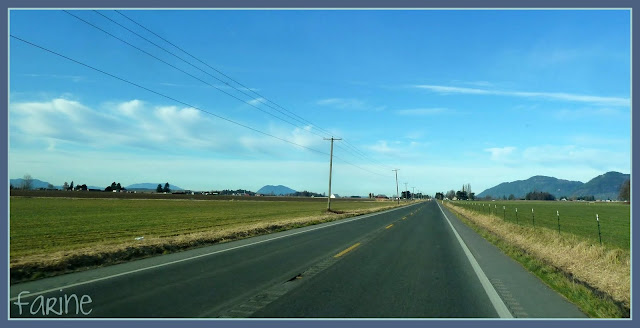
Scott’s bakery is located in beautiful and fertile Skagit Valley in Edison, a village so tiny that if you blink as you reach it, you could pass it and never notice. With Vancouver two hours to the north, Seattle one hour to the south, the Cascade mountains to the east and Puget Sound close by to the west, Edison could be forgiven for thinking of itself as the center of the universe.
But instead of bragging, it has adopted a whimsical last frontier kind of attitude that has you sit up and notice and, yes, make a U-turn and park if you have already driven through…
The bakery sits next to the saloon in an old building that has hosted successively over the years a butcher shop (some of the village old-timers still remember accessing the meat locker in the back), a candlery and an upholsterery shop. When Scott and his wife Renee opened up in July 2003, there was no culture of bread in the area. None. Scott traveled with samples and brochures in his van and explained what they were hoping to do to whomever would listen and have a taste. The samples were a hit: the bread was well-received. Besides the brisk business they do in the shop, they now sell to nine grocery stores as well as to about fifteen restaurants including on the San Juan islands where mail and bread delivery go hand in hand.

Born in nearby Mt Vernon, Scott himself grew up as a fast food kid. His first job (as a high school student) was to wash dishes in a little restaurant in Wallingford. That’s when he discovered flavor. Three months later his newfound passion for food got him promoted to assistant chef. In those years, naturally leavened bread wasn’t on his radar: his chief interest lay in pastries and rolls. After college where he was a chemistry major -to this day he says science helps him a lot in his baking- he saved his money and signed up for a six-week intensive class in baking and pastry at the Culinary Institute of America at Greystone in Napa Valley. With that training under his belt, he started looking for a job. A year later, he landed at Grand Central Bakery in Portland, Oregon, and that’s when the love story started. As Scott remembers it, “I was enthralled from Day 1”.
Nineteen months later, Grand Central transferred him to all-organic Black Bear Bakery as head baker. Talk about trial by fire! But he got a lot of support and it was a fantastic learning experience. Fast forward another year and Grand Central found itself in need of a head baker at its Seattle location. It offered him the job. Scott drove up and spent a week there. Realizing that accepting the offer would the perfect way to round up his training in preparation for going on his own, he laid his cards on the table: he told the owners that his goal was to open his own place and that he would only remain in Seattle until he had the money to do so. But he wouldn’t leave before first training his replacement. It was a deal Grand Central could live with. Scott remained in Seattle four years. Then Breadfarm happened.


I visited shortly before Christmas. The air inside the bakery was redolent with the scent of spices (mostly ginger) and baking levain, a fragrance that does more for me than luxury perfume. I fell under the spell and found myself deploring -once more- that technology hadn’t progressed enough to make it possible for my camera to capture aromas as well as images.

Like miller Kevin Christenson, his almost neighbor and also his main purveyor of whole-grain flours, Scott wants to be part of a sustainable grain-growing, milling and baking local economy.  One of his goals is to be a voice for the bakers by explaining why certain grains work better for them than others (each has its unique aroma and baking characteristics), by stressing the importance of consistency (one of the challenges of local grains is the way flour varies from one delivery to the next due to factors sometimes as simple and basic as changes in the weather) and by pushing for more storage down the road (more storage would allow for blending which would improve consistency). For a baker, consistency trumps local: at this point, Scott has no choice but to get his unbleached white flour from outside the state.
As you can imagine, I had an uphill battle with myself trying to decide which of Breadfarm loaves to feature on Farine. In the end, since I am still new to the area and basically learning its tastes and flavors, discovering the terroir if you will, I decided to go for the Winthrop Whole Wheat bread, made with two kinds of wheat, both grown in Washington. I had tasted it before and liked its nutty aroma. I also liked the fact that even though it was 100% whole wheat, it didn’t stick its wholesomeness in your face with a holier-than-thou kind of attitude: it was light, handsome and very pleasant. In other words, a winner.


Winthrop 100% Whole Wheat (Breadfarm)

Related post: Winthrop 100% Whole Wheat Bread


Share this:

  • Share on Facebook (Opens in new window) Facebook
  • Share on Pinterest (Opens in new window) Pinterest
  • Share on X (Opens in new window) X
  • Email a link to a friend (Opens in new window) Email
  • Print (Opens in new window) Print

January 16, 2012 · Filed Under: Artisans, Bakeries · 6 Comments

Meet the Miller: Kevin Christenson

Except for a natural food store which had probably known better days, there was no source of organic flours of any kind in or near the little town where we used to live in the Northeast. I bought 50-lb bags of wheat, spelt and rye whenever we visited more baker-friendly places and relied on my little mill to supply me with whole-grain flour on demand. If kept at cool temperature, grains will last forever, so I never ran short of the essentials but access to more “exotic” grains such as barley, buckwheat, millet, etc. was another matter. I had no choice but to turn to the natural food store where freshness was sometimes an issue, even in the bulk section where everything looked a bit sorry for itself. So imagine my delight when I heard about Fairhaven Organic Flour Mill, an actual mill located in the Skagit Valley, about one hour away from where we now live now in the Northwest, a mill milling organic whole grains and run by a miller who is a real person, not a corporate entity.
I had liked the various Fairhaven flours which I had tried (our local grocery store carries them bagged and the nearby PCC Market has some of them in bulk) and I thought I’d like to take a closer look. So I contacted Kevin Christenson, the miller, and told him I would love to come and meet him if he was up to a visit by a serious home baker and bread blogger.
We drove up by a beautiful December morning. In the valley, the fields were a patchwork of green and brown (having lived for so long in states where the landscape tends to be monochromatic from early December to the end of March, I marvel at how much color the winter landscape still offers here in the winter). Mount Baker was visible in the distance, snowy and majestic.
The mill is located inland in a new-looking industrial zone but Puget Sound is only a few miles away as we discovered when, after our visit, we drove north along the coast to Bellingham, a quaint little college town with an awesome bookstore and good eateries.
Puget Sound and the San Juan islands
Kevin Christenson was born and raised in Minnesota and has lived and worked in Manhattan for seven years but he is the only miller for miles around (the other organic mill in Washington State, Blue Bird Grain Farms, is located way to the east). As such, he has established strong ties with the local farmers and bakers and if working in close collaboration with those who till the land and feed you, your family and your community doesn’t make you a local, what does?
The mill’s front entrance
The mill’s backyard
Becoming locals was exactly what he and his wife Matsuko had in mind when they decided to move to coastal Washington State to raise their two boys. They had visited the area several times and fallen in love with it. Now they needed to find jobs that would make them bona fide actors on the local scene, jobs that their kids could understand and relate to. It took a while. They bought a house with a garden and lived on what they grew (Kevin had been a home gardener all his life and still grows most of their food) and they relied on their savings for the rest. When he found the mill up for sale on Craigslist (of all places!) in 2007, he had already spent two years researching a business he could try his hand at but everything he found was of the run-of-the-mill (no pun intended!) variety, jobs he could have done just as well in New York or in Minneapolis. Not what he was looking for. The mill was another story.
Then located in the 5,000 foot basement of an old building in Bellingham, it had started in the mid-70’s as a cooperative to provide whole-grain organic flour to the local bakers and homemakers when nobody else was doing it and it had been bought in the 80’s by one of the coop members. The owner was now ready to retire and eager to sell.
From the start, Christenson’s idea was to encourage local farmers to grow more grain. With the support of Stephen Jones, director of the Mount Vernon Northwestern Washington Research and Extension Center (where the first Kneading Conference West took place last September), contacts were established and fair price agreements worked out. Today the mill buys 60% of its grain from Washington State (compared to 20% when the Christensons bought it). The wheat (which used to come mostly from Montana) now comes from Washington farms which Christenson has visited many times: spring red wheat and buckwheat from Walla Walla; barley, soft white wheat and hard red wheat from nearby Lynden. Millet still comes from Montana as do spelt (although Christenson is trying to get some from Eastern Washington), rye, oats and some light barley; brown rice comes from California (none is to be had locally); corn from New Mexico (the 2011 crop didn’t yield enough in Washington). The mill stopped milling soy in 2010 because the source could no longer guarantee it would be free of GMOs.
Thanks to the move to the 7,200 square feet new facility in the fall of 2010, the mill could conceivably double its output of 80 to 100,000 lb a month. But the kids are still young and family life remains top priority, especially with both parents employed at the mill although Matsuko works there only part-time.
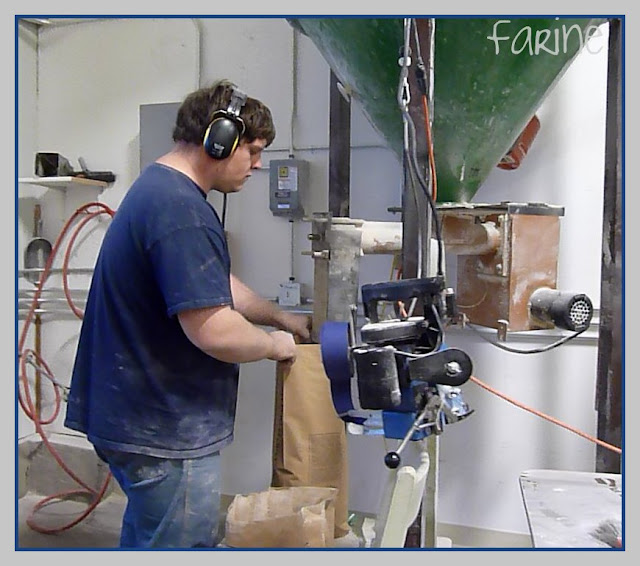
Trevor filling buckwheat flour bags
Altogether the mill employs two full-time and two part-time workers. Kevin never went to milling school (if such a thing exists in the United States) nor is he a baker. He had to learn literally every aspect of the job as he went along (the previous owner stayed on for two months to help with the transition) and, as he sees it, he is still learning every day.  He likes machinery and has always enjoyed fixing whatever broke down. That’s a big plus. He has a business degree. That helps too. Finally he enjoys engaging with people and he is an indefatigable listener: he has frequent contacts with farmers and bakers; he consults with Stephen Jones; he participates in as many grain-related programs and field trips as he can.

His is strictly a whole-grain operation. The organic all-purpose flour sold under the Fairhaven brand actually comes from Central Milling in Utah. Fairhaven isn’t simply not equiped to produce such flour. Christenson is currently working with Snohomish County farmers who are seeking a grant to finance the installation of an organic white flour mill. It would cost over $1.5 million. Fairhaven still uses its original stone mill but only to make coarse meal (which some local bakers order every week). All the other flours are hammermilled.

I bought bags of grain and some flour and on our way out, we saw old posters on the walls of the office. They belonged to the previous owner who was of the back-to-the-earth hippie-ish persuasion. Although Christenson kept the posters, he is more attuned to our times. Intent on making sure his community remains relevant in the global economy, he is keen on doing what he can to foster a sustainable way of life in the Skagit Valley. Listening to him I kept thinking: “This is what it actually means to act locally and think globally. That’s it. In action. With no rhetoric, embellishments or flourishings. Simple as can be.”


Related post: Blackberry Buckwheat Blossoms

Share this:

  • Share on Facebook (Opens in new window) Facebook
  • Share on Pinterest (Opens in new window) Pinterest
  • Share on X (Opens in new window) X
  • Email a link to a friend (Opens in new window) Email
  • Print (Opens in new window) Print

January 4, 2012 · Filed Under: Artisans, Mills, Travel · 10 Comments

Almond-Orange Honey Cakes

In my family, nothing whispers “I love you” more tenderly on the breakfast table than a plump little honey cake fragrant with anise and ginger, so when I stumbled upon an orange-almond paste “pain d’épice” (literally spice bread) on Alter Gusto, a French blog with a myriad of attractive recipes, I decided to make it for New Year’s Day.

There is something inherently happy about spices, don’t you think? They are as old as time itself (nothing faddish about them); because of their medicinal value, most of them are considered beneficial; and finally they are wickedly delicious (the expression “to spice up your life” says it all). In other words, they offer the perfect paradigm for a New Year’s resolution by making it easier to eat well.

Pain d’épice in France is traditionally made with rye. Carole (Alter Gusto‘s owner) used chestnut flour (which she had in abundance) because she couldn’t find any rye flour. I had wholegrain rye flour and that’s what I used (I have yet to find a good chestnut flour in the US). Also traditionally pain d’épice is made without fat or eggs and this one is no exception. Which is a huge plus in my book.
Pain d’épice is customarily sweetened with honey and here a word of caution seems appropriate. According to this article in Food Safety News, some of the honey sold in the US isn’t honey at all and many of the big chain stores we’d think we could trust actually peddle junk under the honey label.
Ingredients: (the recipe was slightly modified to take into account the greater absorption capacity of the American flours compared to the French ones. I also added salt).
  • 160 g whole grain rye flour
  • 80 g unbleached all-purpose flour
  • 70 g almond paste (make sure almonds are listed as the first ingredient on the label)
  • 10 g baking powder
  • 40 g powdered milk (I had none and used whole milk instead to supplement the orange juice)
  • 2 untreated oranges
  • 160 g honey
  • 4.5 g of ground ginger (2 teaspoons)
  • 1.2 g ground cardamom (1/2 teaspoon)
  • 3 cloves
  • .6 g grated nutmeg (1/4 teaspoon)
  • 1 pinch of salt
  • a handful of roughly chopped almonds (optional)
Method:
  1. Wash and dry the oranges. Grate the zest of one of them and set it aside
  2. Squeeze the juice out of both oranges. Add enough milk (or water if using powdered milk) to obtain 200 g of liquid
  3. In a saucepan, heat the honey, the blend of juice and milk (or water), and all the spices. Mix until honey is well incorporated and the liquid hot. Remove from heat. Let stand for 30 minutes then drain out the spices
  4. Pre-heat the oven to 350°F
  5. In a food processor or a blender, mix flours, almond paste and orange zest until powdered. Transfer to a bowl. Add powdered milk (if using) and baking powder. Blend well
  6. Drain the orange juice infusion. Stir the liquid into the dry ingredients until just well combined. Do not overwork
  7. Divide into mini-molds or pour into a bread pan
  8. Garnish with chopped or sliced almonds if desired
  9. Bake for about 30 minutes (a bit longer if using a single large pan)
  10. Cool on a rack.
Happy New Year everyone!

Printable recipe

Share this:

  • Share on Facebook (Opens in new window) Facebook
  • Share on Pinterest (Opens in new window) Pinterest
  • Share on X (Opens in new window) X
  • Email a link to a friend (Opens in new window) Email
  • Print (Opens in new window) Print

December 30, 2011 · Filed Under: Breads, Quickbreads, Recipes · 7 Comments

  • « Previous Page
  • 1
  • …
  • 37
  • 38
  • 39
  • 40
  • 41
  • …
  • 55
  • Next Page »

Hello!

MC-Profile- 2013 - DSC_0934

My name is MC: formerly a translator,  now a serious home baker and a blogger. If you like real bread and love to meet other bakers, you are in the right place. Come on in...

Learn more →

  • Email
  • Facebook
  • Instagram
  • Pinterest
  • RSS
  • Twitter

Don’t want to miss a post?

Subscribe to Farine via email

Archives

Categories

Copyright © 2026 Farine · Design by Design Chicky Log in