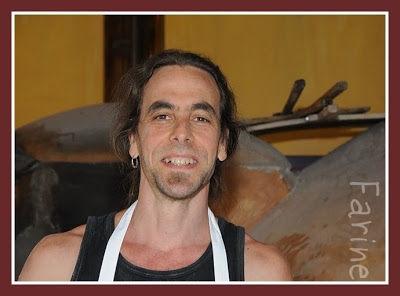
Farine

Crazy for Bread

  • Home
  • About
    • FAQ
  • Recipes
  • Resources
    • BreadCrumbs
    • Other Bread Sites
    • The Grain Gathering
  • Artisans

Search Results for: how to make bread

A Quebec Story

Related stories:

A Visit to Quebec

The Gift of Bread

The Mill on the Rémy

Boulangerie La Rémy

The Meteorite

Frank Cabot: A Man with a Passion

“The economic system of New France was inspired by the feudal model, and it continued for many years after the English conquest. The land-owning seigneurs had several obligations. They had to apportion lots so that the land would be farmed. They had to build a grist mill for their tenant farmers, who were called censitaires, or habitants. For their part, the censitaires were obliged to grind their wheat at the seigneur’s mill and give him one fourteenth of their flour as a toll.” (extract from booklet The Moulin de la Rémy)
The region of Baie-Saint-Paul and Saint-Urbain had been entrusted in 1662 to the Seminary of Quebec which had been parceling it out to settlers ever since. The population was growing fast and in 1806 the Seminary had a wooden mill built on the Rémy to serve its pressing needs. By 1825 however, the wooden mill had fallen in serious disrepair and the Seminary contracted Jacob Fortin to replace it by a much larger stone mill which would include lodgings for the miller and his family. This new mill began operating in 1826-27.
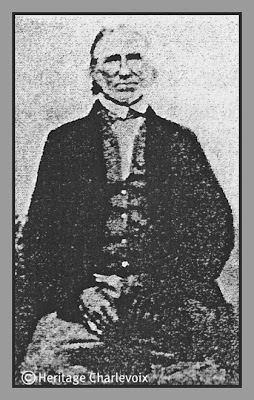
Roger Bouchard

Its first miller was Roger Bouchard from nearby Petite-Rivière-Saint-François, a rather dubious character according to Les Moulins à eau du Québec: du temps des seigneurs au temps d’aujourd’hui by Francine Adam. He appears to have had marital and anger management issues which drove him to an ugly legal dispute with the local priest. I won’t get into details but, to put it mildly, his poor wife seems to have had few reasons to be happy in her new home. He operated the mill for 8 years during which it almost burned down (as the story goes, the mill was spared because God agreed to turn the wind around after the priests at the Seminary notified Him of its imminent destruction) and otherwise deteriorated. However, maybe because he fell seriously behind in what he owed the Seminary, when the miller left the region in 1850 to build and operate a sawmill further north, he was considered a wealthy man.

The millers who succeeded him were not as colorful and although their names survived (I was gratified to spot a woman among them, Marie Fortin Simard, a widow who operated the mill from 1880 to 1884 before entrusting it to her sons), not much else is known. From 1902 to 1991, the mill remained in the hands of the Fortin family: Cléophase Fortin was the miller from 1902 to 1909, Robert Fortin from 1909 to 1951 and finally Félix Fortin from 1951 to 1991.
Félix Fortin
(photo from booklet The Moulin de la Rémy)
By all accounts, Félix was deeply attached to his mill and cared for it in the best way he could but he didn’t have money to make the necessary repairs: the north wall had crumbled, sending stones tumbling down as far as the river. The great waterwheel was gone. The façade had cracked following a series of earthquakes. No longer able to produce flour, Félix kept producing dry animal feed until he retired. The going was tough however as he had to compete with the new industrial mills.


At the time of his retirement in 1991, he had few reasons to believe his mill would ever be back to what it was in its prime, let alone be operated again. But Heritage Charlevoix bought it in 1992 and the rest is history… (see

The Mill on the Rémy

)

As can be seen from the following picture though…
…while the old mill was surrounded by various outbuildings (the barn and the root cellar have been restored already and the outdoors bread oven will soon be reinstalled), there was nothing near it resembling a bakery. Since Frank Cabot’s dream was to restore bread to Charlevoix County (see

The Gift of Bread

), a building had to be either found or built. Bent on preserving the county’s heritage, Frank opted for the second solution. Heritage Charlevoix purchased an abandoned farm building in nearby Sainte-Irénée, had it sliced in half, and carried to the site on trucks.

Once the bottom part of the house safely set on its new foundations, the ovens were trucked in. Built 27 miles (45 km) away in Jean-Claude Bernier’s workshop, these replicas of eighteenth-century French wood-fire ovens each weighed more than 40 tons. I would have loved to show you a picture of the ovens lifted with a crane and set in their assigned spots and, even better, a photo of the old roof flying through the sky to be reunited with the bottom part of the farm house but none is available that I know of and we’ll have to be content with a picture of the bakery today.

For all practical info regarding the mill and/or the bakery, please refer to the Moulin de la Rémy’s website.

Share this:

  • Click to share on Facebook (Opens in new window) Facebook
  • Click to share on Pinterest (Opens in new window) Pinterest
  • Click to share on X (Opens in new window) X
  • Click to email a link to a friend (Opens in new window) Email
  • Click to print (Opens in new window) Print

July 26, 2010 · Filed Under: Travel · Leave a Comment

Frank Cabot: A Man with a Passion

Photo by Richard W. Brown

Reproduced by courtesy of Frank Cabot

Related stories:

A Visit to Quebec

The Gift of Bread

The Mill on the Rémy

Boulangerie La Rémy

The Meteorite

A Quebec Story


A man with a cause (see

The Gift of Bread

) is generally a man with a passion. Frank Cabot is no exception. Bringing good bread back to Charlevoix County was a worthwhile cause and he made sure he achieved his goal, spurred on by his wife’s unfailing enthusiasm and support. But he isn’t a bread warrior. For him, the bread issue is part of a larger rescue operation: preserving the legacy of the past in the county. His true passion lies in creating gardens.

A self-proclaimed romantic when it comes to landscape and food, Frank became a gardener when he married Anne Perkins, herself fascinated with plants. Their garden at Les Quatre Vents in La Malbaie, Quebec, has been acclaimed as one of the most beautiful gardens in North America. It wouldn’t belong on this baker’s blog however except for the link between Frank, Anne and

Boulangerie La Rémy

.

I first met Frank through the book he wrote about his garden’s history, The Greater Perfection: The Story of the Gardens at Les Quatre Vents, a fair portion of which can be read online courtesy of Google Books. (For the passionate gardeners among you who simply must have the book despite its cost, please note that Hortus Press sells it for less money than amazon.com).

The Greater Perfection – which Frank calls the garden’s own autobiography – makes for lovely reading (a friend lent it to me and I couldn’t tear myself away) and when I met Frank and had a chance to hear him talk about the mill and the bakery, I was struck by the similarity between his approach to bread as part of the larger culture and his conception of the garden as part of the larger natural landscape. He clearly knows where Man stands in Nature. He is also very aware of the fact that for a society to keep its identity overtime, the Past must leaven the Present. The same holds true for a person or for a garden.

Les Quatre-Vents was 75 years in the making and while very much bearing the signature of its current owners, it clearly remembers the previous generations: the horizontal lines that anchor the house to the landscape, the tree-lined drive up to the house, the carpet of plain green lawn, the framed vista of the distant hills, all were dreamed up by previous stewards of the land.

I like to imagine Frank looking at it as one looks at a photo album, recalling loved ones, distant countries, reluctant plants, forgotten memories but wondering at the blank pages waiting to be filled. What will they hold? Who will browse through them?
Anxious that the garden should continue to exist and not “deteriorate once the shadow of its patron no longer hovers, until it becomes what French writer Colette referred to as “le débris d’un rêve” (the remnants of a dream)”, Frank and Anne have put in place a legal mechanism, the Charlevoix Trust, that will carry it into the final quarter of this century. To their deep satisfaction, their son Colin has agreed to take responsibility for Les Quatre-Vents when his turn comes. Again this doesn’t have much to do with bread and yet in my mind, there is a link.

When I feed my levain, morning and night, inhaling the complex and rustic fragrance of the freshly milled grains, I feel my hands come alive with the gestures of countless generations of women who have been baking bread in my family over the centuries. When our grand-children help with the scaling and mixing or simply when they tear eagerly into the loaves I make for them, I know that, on another continent and in a different language, they are acquiring the taste of bread and, beyond bread, being handed a thread of their past to weave into their present and their future. It feels right. I imagine that, on a much larger scale, Frank and Anne have the same feeling when they look back at what they have achieved.

For all practical info regarding the mill and/or the bakery, please refer to the Moulin de la Rémy’s website.

Share this:

  • Click to share on Facebook (Opens in new window) Facebook
  • Click to share on Pinterest (Opens in new window) Pinterest
  • Click to share on X (Opens in new window) X
  • Click to email a link to a friend (Opens in new window) Email
  • Click to print (Opens in new window) Print

July 26, 2010 · Filed Under: Travel · 2 Comments

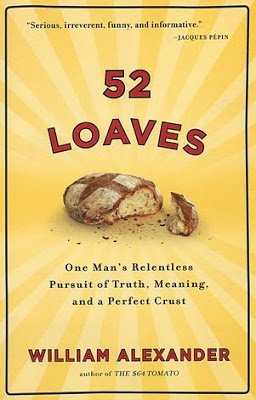
52 loaves – One Man’s Relentless Pursuit of Truth, Meaning and a Perfect Crust

First book in a long time to make me me laugh out loud! William Alexander makes the quest for the perfect crust (crumb, actually, since he spends the better part of one year trying to get holes in his bread) sound both like the single-minded obsession of a slightly demented home baker (when he isn’t baking, Alexander is director of technology at a research institute) and a somewhat comical endeavor which ends up involving the whole family one way or another.

Having heard that the secret to authentic French bread is authentic French spring water, he goes out and buys a bottle of Evian, “delivered straight from the French Alps,” fully expecting that his bread, “once liberated from its chlorinated, acidic manacles, would rise in the oven like a soufflé, tasting of the Alps, evoking the character of Jean-Paul Belmondo and the eroticism of Brigitte Bardot.” But even if it had done so (and it hadn’t), it wouldn’t have satisfied him. Carbon footprint aside, “I wanted my bread to have that terrroir, the taste of the land, and when the Hudson Valley wheat growing in my garden matured, I wanted to bake it with Hudson Valley water.”

Yes, growing in his garden, you read that correctly. Not satisfied with flour that could be bought at the supermarket, Alexander had decided to grow his own wheat (from scratch, literally) and, with the help of his wife, Anne, a medical doctor, planted four beds of winter wheat.
Discovering how he and his family dealt with the harvesting (“after a few useless swings with my old, rusty scythe – essentially a sickle on a long pole – I went into the basement and emerged with my not-quite-as-rusty hedge shears,”) the threshing (first with an old broom, then with a shovel, then with a mallet), the winnowing (first relying on the wind to separate the wheat from the chaff, then resorting to more technologically advanced solutions) and the milling (using an Indian artifact grindstone), not to mention the efforts which went into building a brick-oven, makes for fun and instructive reading.
Along the way, the author reviews the history of bread, learns about the various types of flour, reflects on the link between bread and religion, researches the origin of pellagra, a mystery disease that has disappeared in our part of the world thanks to the systematic addition of niacin to white flour, muses about modern milling, deals a swift blow to bread machines (they seem “to have been designed to reproduce not artisan bread but commercial bread, the cellophane-wrapped kind”) and has with levain an encounter that changes his life. He actually becomes so attached to his that he takes it with him to France: his description of how he gets it through security at JFK is most entertaining. My only reservation about the book has to do with the frequent asides about the author’s libido which, I suspect, were put in to make the book more appealing to a general public perceived as having voyeuristic tendencies (although I don’t know that voyeurs would rush to purchase a book entitled 52 loaves).
When the book begins, Alexander’s loaves are so dense his kids refuse to slice them themselves, “it was so difficult – not to mention hazardous,” but they eat them anyway and say they are pretty good, unwittingly irritating their Dad who deems them “lousy” (the loaves, not his kids!). Deeply unsatisfied with his bread, he resolves to take a scientific approach, to read books and to talk to bakers.
He thus discovers preferments, learns the merits of gently folding the dough instead of punching it down à la Julia Child, visits yeast factories, goes to baking school in Paris (at the Ritz, no less), flies from Paris to Morocco to bake his bread in a communal oven (Alexander’s description of his stay in Asilah is both hilarious and moving) and, last but not least, spends a few days at Saint-Wandrille Abbey in Normandy where he has been asked to teach the monks the forgotten art of bread-baking.
I love the author’s description of all things French, from the quirky way general strikes operate (they start the evening before the declared date) to the invariably cheerful tone used by hotel clerks to deny a tourist’s legitimate requests. Of course, being French, I don’t get the cheerful tone when in France, just the un-helpfulness, so, unbeknownst to him, he actually has it better than the natives! (Just kidding, readers!)
Alexander fares better with the monks than with hotel clerks. Not being particularly religious himself (“Would you call yourself an atheist, Dad?” asks his teenage daughter. “Not as long as Grandma’s alive”, replies the author as he kneads), he expected his experience at the Abbey to be one of an outsider looking in but it turns out quite different.
After the first bake, he goes for a long walk: “I had been out for two hours, and not once had I encountered another living soul. The thoughts occurred to me that I was more likely to encounter God. Not that I really expected to, but it did, for the first and only time in my life, seem possible in this ancient , otherwordly place to realize some kind of divine experience: a vision, a voice, an epiphany. I stayed on my toes, alert to His presence, but all I could see were the timeless ruins, the sparkling stream, flowers and herbs, fruit trees heavy with ripe apples and pears, birds chirping in the trees, church bells ringing in the distance, all of it drenched in that incredible Norman sunshine, and, above all, perfect, transcendental solitude.”
He devises for the monks a bread that can be made without compromising their attendance at the seven daily offices, the performance of their tasks and their participation in study groups, the “pain de l’Abbaye Saint-Wandrille“.
You will find recipes, a photo tour of the Abbaye (including a video clip of the ancient mixer at work) and other delectable tidbits on William Alexander‘s website.

Share this:

  • Click to share on Facebook (Opens in new window) Facebook
  • Click to share on Pinterest (Opens in new window) Pinterest
  • Click to share on X (Opens in new window) X
  • Click to email a link to a friend (Opens in new window) Email
  • Click to print (Opens in new window) Print

May 27, 2010 · Filed Under: Books, Resources · 7 Comments

Meet the Baker: Jonathan Stevens

…or, rather meet the baker Jonathan Stevens and the fire-maker/minder, Cheryl Maffei, since they operate Hungry Ghost Bread in Northampton, Massachusetts, as a team.

This is my second visit to the bakery. The first one occurred on a Saturday last year. The bakery was so busy and active that morning that I didn’t even attempt to introduce myself. I breathed in the heavenly smells, bought a few loaves and left. In any case, I always like to check out the bread before talking to the baker. So check out the bread I did as soon as we got home and I loved it and made plans to return!
Little did I know when we sampled that beet bear paw that we were actually eating a loaf made with local grains. “Locavorism” (is there such a word?) is big at the Hungry Ghost, so big that wheat is grown on a patch of land right in front of the bakery:

>

Admittedly that patch of wheat is mostly symbolic but, as Jonathan puts it, it helps local kids establish a link between the bread and the grain. My 5-year old grand-daughter has seen/helped me mill grains and make bread so many times that there is no way she can think it comes naturally pre-sliced in a plastic bag but other kids might. After all, she maintains that in her house, hamburgers do not come from cows but from the supermarket and on one occasion I overheard her inviting her little brother to come outside and help her “plant a chicken”. So, from my point of view, a little visual reinforcement never hurts.
Hopefully grown-ups don’t have to be told where bread comes from but the wheat patch underlines the message that “amber waves of grain” need not be limited to Kansas, Montana or the Dakotas. Research has shown that wheat was grown in the Pioneer Valley (the name designates the three counties through which the Connecticut River flows in Massachusetts) as early as 1602 and a 95-year old friend of Jonathan’s whose parents owned a mill in North Amherst remembers local farmers bringing wheat, rye and corn to his family for milling.

After World War II, all grain production was centralized in the Western Plains where it could be done on a massive scale, free of pests such as blight. There was no perceived need to grow grain locally and as farm land became more and more valuable, farmers gave the preference to high-yield crops such as tobacco.
When they first started the bakery 10 years ago, Jonathan and Cheryl purchased their flour from a major flour distributor in a neighboring state. That distributor hasn’t operated a mill in a 100 years: it gets its grain on the commodity market and has it milled in North Carolina. Jonathan and Cheryl found it very difficult to reconcile their organic bread baking with such a huge carbon footprint. They wanted to bake from wheat grown locally or, at any rate, closer.

In March 2007, they put a call to farmers, saying that if they grew wheat, they’d buy it.
Leslie Cox, Manager of the Farm Center at Hampshire College (which, incidentally, is Jonathan’s alma mater) called to say that it wasn’t that simple. Cox, who comes from a family which has been growing wheat for generations in upstate New York, explained that there were 10,000 varieties of wheat, not all good for bread (his own family grew wheat mostly for pastry flour) . It is very wet in Massachusetts, which could be a problem, and the infrastructure needed to harvest, store and process the grain would be very expensive.
A meeting was organized at Hampshire College. Farmers were invited, as well as students and bakers. The outcome of the discussions was that the farmers would need a lot of help before any project could be launched. They needed to find out which varieties grew well in the Valley. A few were willing to experiment but there was no way around the fact that the infrastructure would be enormously expensive. Centrally milling the grain could cost up to one million dollars. What to do? Apply for federal funds? Resort to a massive fund-raising effort?
Maffei has a strong background in community organizing. She launched a grass-root appeal for volunteers to grow each 100 square feet of a specific variety. For more info, listen to this NPR radio program:

Over a hundred people (among whom many of their customers) responded. Coinciding as it did with the tripling of the wheat price in 2007, this renewed interest in local grains attracted the attention of CNN, the New York Times and MSNBC. The press coverage did a lot to promote the project and give it legitimacy.

Simultaneously Stevens and Maffei discovered La Meunerie milanaise, which gets most of its grain from Quebec farmers (it only purchases out West what cannot be grown locally). Quebec wasn’t the Valley but it was a lot closer than Montana and the example was electrifying: if wheat could be successfully grown in Quebec, then it could be done in Massachusetts. Together with the volunteers, they started growing the same varieties as the Quebec farmers, while working tirelessly to raise awareness about issues related to the commodity market and the need for a local supply of grain.

Word spread and more farmers started quietly to grow wheat (a great rotational crop in organic farming). At White Moon Farm in Easthampton, Carol and Ron Laurin grew seeds they got from a supplier. The following year, two more farmers (Lazy Acres and Plainville Farm in Hadley) agreed to try it in little patches. Out of the blue, Four Star Farm in Northfield (which used to grow turf for golf courses) planted 18 acres of pastry wheat, giving Jonathan and Cheryl the immense satisfaction of being finally able to use local flour in their crackers, cookies and other pastries.

But it wasn’t enough. Stevens – who, besides being a self-taught baker, is also a musician and a poet – and Maffei – who grew up in a large family in Boston and is passionate about food and cooking – wanted to grow more than the symbolic wheat patch in front of the bakery. They wanted to move the project forward by producing seeds themselves.

In June 2009, they attended the RENABIOS meeting in South-Western France. Renabios stands for “Renaissance de la biodiversité céréalière et du savoir-faire paysan” (Re-birth of cereals biodiversity and farmers’ traditional skills). The meeting was organized by the Réseau Semences paysannes (Farmers’ Seeds Network), created in 2003 to counter the tremendous loss of seed diversity and rusticity entailed by the agrobusiness model and to encourage the selection and multiplication of seeds at the farm level.
The Renabios meeting brought together farmers and artisans from 18 different countries, from Europe to the Middle-East, to share what they knew about the culture and uses of wheat and other cereals. (If you are interested in seeing pictures of that colorful event, I highly recommend browsing through Nathalie Bede’s gorgeous Renabios 09 album).
The Renabios farmers and artisans were also sharing ancient seeds, many of them actually not approved for cultivation in the European Union. Since the grain isn’t “legal”, they can’t sell the flour but they can use it to make bread and they sell that bread at farmers’ markets or in little shops. All of them are fiercely opposed to GMOs. Stevens and Maffei found the energy and dedication of these “paysans-boulangers” (farmers-bakers) well suited to the lone-wolf mentality that prevails in the Pioneer Valley of Western Massachusetts where farmers are struggling with the loss of the necessary infrastructure. Smaller used combines might be found to harvest the grain, the wheat might be milled in smaller mills which the farmers could operate themselves. Money might be procured under the Federal Farm bill through the value-added grant program.

Daughter Nia who is in charge of the savory folds

Stevens and Maffei moved last month to a 26-acre farm in Montague, Ma, about 20-25 minutes from the bakery. Sloped but terraced, the land hasn’t been cultivated in 60 years. They will farm it in partnership with Rich Gallo, an apprentice organic farmer, and with the support of nearby professional farmers who have agreed to help with the equipment. The soil is beautiful, says Maffei. They will do two tillings, plant buckwheat in July, then in the fall sow ancient varieties of wheat (including Red Lama). After the harvest, the seeds will be distributed to farmers.
They will grow some clover for nitrogen and to cut down the weeds. In spring and summer, they will also grow a significant amount of herbs (including lots of basil to make pesto).
They are hoping the farm will also provide a space for the bread-making classes the community has been requesting for some years. In the beginning they’ll probably put in a small wood-oven but ideally they’d love a traveling oven which would enable them to reach other communities as well. The mixing will be done by hand since older varieties are more fragile and in any case the romance of hand-mixing appeals to aspiring bakers.
These new projects will take them away from the bakery for a few days each week but they now have a solid team of helpers who can manage operations when they are not around. Just as Stevens likes to stay in tune with the dough and doesn’t make exactly the same loaves from one batch to the next, he plans to remain attuned to the needs of the land and of the community and to shape his days accordingly. He sees variety as a form of personal renewal.
This passion for diversity is reflected in the bread schedule which provides pretty much for every taste. I was struck by the creativity with which Stevens conjugates the local loaf (bread made with local wheat): so far, besides the beet bear claw, I have tried the double wheat and the flatbread with coriander and each time I was astonished by the boldness of the flavors. I haven’t sampled all the breads yet but among those I have tried, I loved the olive fougasse and the semolina fennel and, for now, my absolute favorites remain the spelt loaf with chamomille and the French bâtard, both excellent. I was less impressed by the savory fold which featured so much thyme that it masked the taste of the other ingredients – white cheddar, sun-dried tomatoes, baby bella mushrooms and onion (in the interest of full disclosure, I must say that thyme is my least favorite herb, so maybe it was just me).
Stevens started as a home baker when he was a stay-at-home Dad. His first loaf was the pan bread from the Tassajara Bread Book, then he graduated to the country boule with starter and yeast. After his second son was born, he built an oven in the backyard. Then he bought a mixer and just extrapolated his knowledge. He sold his bread first to his sons’ friends’ parents, then to CSA’s. He attended Alan Scott’s gatherings out in Marin County, north of San Francisco, where nobody was an expert and knowledge-sharing was the rule. Peer education at its best! It enabled him to improve what he was doing. Later, he just learned from doing it over and over again. Stevens’ mantra today: pay attention and retard the dough. It makes all the difference…
For practical details such as address and business hours, please refer to the bakery’s excellent website where you’ll also find a trove of information regarding the back-to-local wheat movement, last year’s French experience , other rewiews, press coverage, etc. You’ll also discover the origin of the bakery’s lovely and mysterious name.

Share this:

  • Click to share on Facebook (Opens in new window) Facebook
  • Click to share on Pinterest (Opens in new window) Pinterest
  • Click to share on X (Opens in new window) X
  • Click to email a link to a friend (Opens in new window) Email
  • Click to print (Opens in new window) Print

May 10, 2010 · Filed Under: Artisans · 6 Comments

JT’s 85×3

This bread with an improbable name is the one which won its creator John Tredgold (aka JT) a spot on Bread Team USA 2010, so you’d better believe it’s good. It is in fact awesome, so much so that it will become a fixture in my house on baking days. You should have seen the speed at which it was wolfed down by my grandchildren when I brought the loaves over. Everyone went back for seconds and thirds, from the 3-year old twins to their teenage brother and sister. Of course the older kids were completely unaware when devouring it that they were ingesting the very same healthful whole grains as the ones they scorn when listed on the wrapper of a supermarket sliced loaf. Nothing like a deliciously crunchy crust and a complex taste to make you forget your dearest principles!

The 85×3 gets its matchless aromas from a high-extraction flour as well as from the use of three different preferments, a biga, a poolish and a levain. The biga and the levain are made with 100% high-extraction flour while the poolish uses regular bread flour.

JT used Artisan Old Country Organic Type 85 malted Wheat Flour (ash content: 0.85%) from Central Milling. I didn’t have access to that flour, so I used La Milanaise‘s “farine tamisée” which contains just a tad more bran. La Milanaise flours are not sold retail in this country. I got mine from a friend who owns a bakery. If you don’t have access to a high-extraction flour, a reasonable substitute would be to use 80% organic white flour and 20% whole wheat flour.

I didn’t have raw wheat germ, so I left it out of the recipe. Also because it was cool in my house (much cooler than in the bakery at Semifreddi’s), the poolish and the biga took their own sweet time to ferment and I ended up mixing the final dough too late in the day to contemplate baking before night. So I left the dough at room temperature (about 64 F/18C) for one hour, folded it once and put it in the fridge (on the top shelf where it is a tad less cold). The following morning, I took it out, gave it a fold and let it come back to room temperature (one hour and a half to two hours) before dividing, shaping, etc.

JT’s original formula can be be found here. The recipe below is my interpretation.

Ingredients: (for 2 bâtards, 1 fendu, 2 crowns and 1 boule)

Biga
190 g high-extraction flour
114 g water
0.003 g salt (a tiny tiny pinch, basically a few grains)
0.003 g instant yeast (a tiny tiny pinch too)
Poolish
190 g organic white flour
209 g water
0.003 g salt
0.003 g instant yeast
Levain (mine was 40% whole-grain, mostly wheat and spelt with a little bit of rye)
380 g high-extraction flour
209 g water
190 g firm starter
Final dough
631 g high-extraction flour
353 g organic white flour
761 g water (I used slightly less water than JT, probably because my flours were less thirsty than the ones he used)
34 g salt
0.17 g instant yeast
305 g biga
400 g poolish
780 g levain

Method (this bread is made over two days)

  1. Mix the biga, the poolish and the levain and leave them to ferment at room temperature for 10 to 12 hours
  2. When the preferments are ready, mix flour, poolish and 80% of the water in the bowl of the mixer until the flour is completely hydrated and let rest for 30 minutes (autolyse)
  3. Add the biga, the levain, the yeast, the salt and remaining wateras needed and mix until the dough starts to develop strength, then add more water until medium soft consistency is reached (JT says: “A second water addition is used for this mix. I tend to prefer this style of mixing. Instead of holding back say 5-10% of the water and dribbling it into the bowl when you feel comfortable. I like to create the final dough and on the last minute throw all the water in one go. The dough will start to shred and start ‘swimming’. Do not panic and add flour! It’s a bit like accelerating through a skid, Don’t put your foot on the brake”)
  4. Transfer the dough to an oiled container, cover it tightly
  5. Give it a fold after one hour then put the container in the fridge overnight
  6. In the morning, take the dough out of the fridge and give it a fold
  7. Let it come back to low room temperature and divide by 500 g, preshaping as cylinders or boules according to the desired shapes
  8. Shape and let proof, covered, for one to one and a half hour
  9. Pre-heat the oven to 470 F/243 C one hour before baking (my oven doesn’t heat very well. A lower temperature setting might work just fine in your oven), taking care to put it in a baking stone and, underneath, a heavy metal pan for steaming (mine contains barbecue stones which we bought solely for steaming purposes)
  10. Dust with flour and score as desired (as can be seen from the above pictures, deep scoring and angled surface scoring yield very different “ears” in the final loaves)
  11. Pour a cup of water over the barbecue stones in the steam tray, lower the oven temperature to 450 F/232 C and bake for 40 minutes
  12. JT recommends turning off the heat after 30 minutes and leaving the bread an additional 15 minutes in the oven with the door ajar. I will try that next time as I found the crumb a little bit moist when I first sliced open one of the cooled loaves.

Related post: Meet the Baker: John Tredgold

JT’s 85×3 goes to Susan, from Wild Yeast for Yeastpotting.

Share this:

  • Click to share on Facebook (Opens in new window) Facebook
  • Click to share on Pinterest (Opens in new window) Pinterest
  • Click to share on X (Opens in new window) X
  • Click to email a link to a friend (Opens in new window) Email
  • Click to print (Opens in new window) Print

April 20, 2010 · Filed Under: Breads, Breads made with starter, Recipes, Yeasted breads · 12 Comments

  • « Previous Page
  • 1
  • …
  • 43
  • 44
  • 45
  • 46
  • 47
  • …
  • 55
  • Next Page »

Hello!

MC-Profile- 2013 - DSC_0934

My name is MC: formerly a translator,  now a serious home baker and a blogger. If you like real bread and love to meet other bakers, you are in the right place. Come on in...

Learn more →

  • Email
  • Facebook
  • Instagram
  • Pinterest
  • RSS
  • Twitter

Don’t want to miss a post?

Subscribe to Farine via email

Archives

Categories

Copyright © 2025 Farine · Design by Design Chicky Log in